


Alaska: Fairbanks (plus a Lookback to St. Louis)


We arrived in Alaska in June 2025!

Alison's notes for this part of the drive are "Kluane [Lake, Yukon] to Tok [Alaska]: Some brutal road!" Indeed, parts of our trip lived up to the reputation for terrible road conditions. The frost heaves and dirt washboards from Destruction Bay, Yukon, to Tok, Alaska, on the Alaska Highway (225 miles), and, later, from Cantwell to Paxson, Alaska, on the Denali Highway (134 miles) were particularly treacherous, requiring us to slow down to 10-15 mph. There were also slowdowns outside of Fairbanks, Alaska, and, later, Dawson City, Yukon, for road construction, and elsewhere for sections of road that were kept graveled rather than paved (due to underground permafrost creating "waves" in the road as it freezes and thaws). And we did not even attempt to take our rig on the tough gravel roads up to the Arctic Circle (Dalton Highway, Alaska, and Dempster Highway, Yukon). In general, though, we found the warnings to be a bit alarmist. If you've driven the I-10 through Louisiana, you've driven equally rattly conditions! (Although at higher speeds.) We took it very slowly when necessary and came through our trip with only one piece of real damage: we broke our electric step hitting a large rock on a steep dirt driveway out of the Watson Lake Sign Post Forest. It turned out to be walking distance from our campground, so we hadn't even needed to drive through that parking lot on our way in, much to our chagrin!


Crossing the border was very quick and easy. The hard part was just down the road, pulling into the parking lots with every other road traveler to snap the obligatory border sign photos!
After miles of predominantly black spruce forests on the Yukon side of the border, on the Alaska side of the border, the better-drained, south-facing slopes supported forests of white spruce, paper birch, and quaking aspen.


The Knotty Shop outside Fairbanks, Alaska, includes a burlwood porch and a (practically mandatory) wildlife display.

Fairbanks is the second largest city in Alaska, with a city population of about 33,000 and a borough population of about 96,000. We camped at Fort Wainwright (Doug's retired Army reservist status once again helping us out). This was the farthest north that the rig would travel. (Doug and Alison would travel by plane to the Arctic Ocean later in the trip.)

Fairbanks also yielded our fullest experience yet of the Midnight Sun: just three days after the summer solstice, we were getting about 22 hours of daylight and 2 hours of twilight. It truly did make it impossible to feel that it was bedtime at any reasonable hour!
The Fairbanks area is flush with fascinating museums and intriguing activities. Our first outing was to the nearby Chena Hot Springs (which, along with the previously-visited Liard River Hot Springs in British Columbia, created a bit of a theme for our time spent with Isabel). The Chena Hot Springs are part of a resort that also includes indoor pools, an ice museum, hotel rooms and camping cabins and sites, and a Northern Lights viewing area (for winter visitors).

The exterior of the Aurora Ice Museum; Isabel receives an appletini in a sculpted ice glass at the Ice Bar; the Ice Museum workshop; an interior space of the Ice Museum (Chena Hot Springs Resort, Alaska).
The three of us had a wonderful visit to the University of Alaska Fairbanks (UAF) Robert G. White Large Animal Research Station (LARS), where we saw and learned about muskoxen and reindeer. (There were also Canadian wood bison being hosted on UAF LARS grazing ground before being released into Alaska to replace herds that were wiped out in the early 1900s.)
Muskoxen are a kind of Ice Age sheep originating some 600,000 years ago. They are peaceful-seeming grazers, until a male stomps and charges at an interloper or, during the early fall mating season, rams another male's head repeatedly while competing for a female. Female muskoxen also have horns, and will join in a defensive outward-facing circle with the males if predators approach. Their outer coats are coarse and long; their soft, insulating undercoat ("qiviut") is shed annually and can be spun into a very fine, very expensive yarn. (Alison did later purchase one skein of yarn for our older daughter who knits!)

Reindeer are a sub-species of caribou that were domesticated in Siberia and imported to Alaska in the 1890's as a herdable food source. Wild caribou had appeared in Yukon and Alaska some 2 million years prior, but were never domesticated; instead, indigenous North Americans hunted them. We did finally see wild caribou later in our trip, in Denali National Park; otherwise, it was reindeer that we viewed at various zoos and parks. As with muskoxen and their horns, male reindeer will battle each other with their antlers during the late fall mating season, but they shed their antlers, unlike with horns, each year. Female reindeer also grow antlers, keeping them into the winter in order to scratch through the snow for forage and to protect their calves. (Reindeer and caribou are the only members of the deer family whose females grow antlers.)

We also visited the University of Alaska Fairbanks (UAF) Museum of the North, an almost overwhelming collection of exhibits on Alaskan culture and nature. The main gallery is divided into five regions, and it was fascinating comparing the different types of artifacts and taxidermied wildlife. The art gallery held a comprehensive display of historical and contemporary Alaskan art. This museum is a must for visitors!

Sadly, it was now time to bid Isabel goodbye as she returned to Florida to start her post-graduate counseling career; but Doug and Alison had a few more days to explore Fairbanks further.
We really enjoyed the Riverboat Discovery Cruise. Alison had thought it would be too touristy or kitschy, but it was actually the best-run tour experience she had ever been on. (Though we do believe that we picked up Covid from one of the many onboard tourists that had been bused in by a cruise line...) The sternwheeler steamboat cruises through Fairbanks down the clear-water Chena River to its confluence with the silty, glacier-fed Tanana River, and then cruises back. The tour includes a bush pilot landing and takeoff on the river next to the boat; a pause at Trail Breaker Kennel for a sled dog demonstration by Tekla Butcher-Monson, musher and daughter of four-time Iditarod champion musher Susan Butcher; a stop at a re-created Athabascan fishing camp and village, including Alaskan Husky and reindeer encounters and really interesting talks by indigenous guides; and a tasting of delicious smoked salmon dip. (Yes, Alison did purchase several cans of smoked salmon for herself and as Christmas gifts!)


We also visited the Morris Thompson Cultural and Visitor Center in downtown Fairbanks, which had lovely and interesting grounds and exhibits.
On the grounds of the Morris Thompson Cultural and Visitor Center (Fairbanks, Alaska).
From Fairbanks, we traveled south to Denali State Park (where our participation in the RVing to Alaska Facebook group's Rendezvous Under Denali 2025 Rally was cut short by our coming down with Covid) and then to Anchorage, Alaska, where our next blog post will pick up.
Catching Up with Wildlife
We left out some wildlife sightings from our last blog post about Yukon. So here is the tally from Yukon plus the highway to Fairbanks:
Black bear crossing road west of Teslin, Yukon.
Another bear (possibly a brown/grizzly rather than black bear) crossing road farther west of Teslin, Yukon. Unless you can really focus on the shoulder hump and facial structure, it can be hard to differentiate between the two species; color and size vary in both black and brown (grizzly) bears.
Arctic ground squirrel running across the road east of Haines Junction, Yukon. (They like the loosened soil at the edges of roads for their burrow construction.)
Two brown (grizzly) bears crossing road near Kluane Lake, Yukon. (They were relatively thin males, only two months into their six-month active period.)
Female (cow) moose breakfasting on dandelions in a residential front yard in Delta Junction, Alaska. (This sighting surprised Alison and Hershey on their early morning walk; from a distance, it looked like a sculpture of a horse, then it moved and was revealed as a moose! Moose are surprisingly larger than we expected, in this case taller than the car in the driveway next to it.)


Looking Back: July 2024 in St. Louis
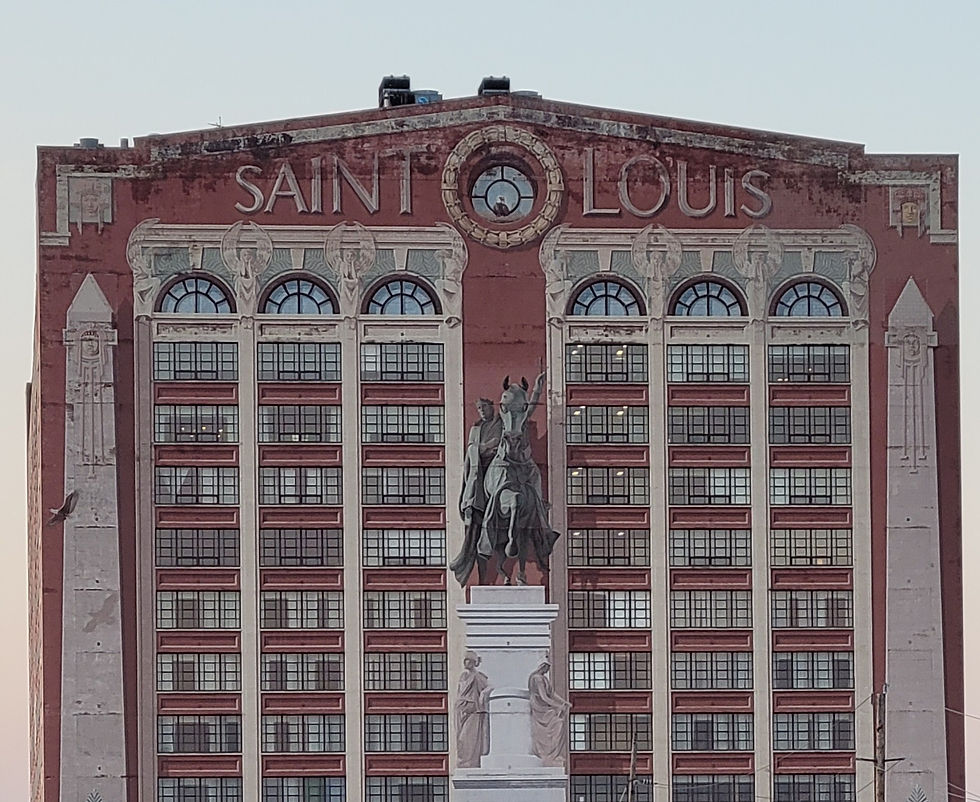
Not quite a year earlier, we had been in another city near the confluence of two rivers: St. Louis, Missouri, where the Missouri River flows into the Mississippi River. The Missouri River begins near Bozeman, Montana, then flows through North and South Dakota, Nebraska, and Kansas, before emptying into the Mighty Mississippi on the north side of St. Louis. By this point, the Mississippi River has flowed out of Lake Itasca in northern Minnesota, then formed the boundary between the states of Minnesota, Iowa, and Missouri on its west bank and Wisconsin and Illinois on its east bank.
The Mississippi River has long served as a route for transportation, beginning with Native Americans and then European explorers and settlers, and commerce, including the fur trade from St. Louis and the cotton trade from Natchez, Mississippi, to the international port city of New Orleans, Louisiana. In the late 1800s, when railroads supplanted steamboats, the Mississippi River became less essential, but the river still remains vital today for transport of bulk goods such as grains, chemicals, and construction materials.
After the Louisiana Purchase of 1803, which included a transfer of the city of St. Louis from France to the U.S., President Thomas Jefferson tasked Meriwether Lewis and William Clark to explore the opportunities of expansion westward from the Mississippi River. Their 1804-1806 Corps of Discovery Expedition navigated the Missouri River upstream through the lands of the Louisiana Purchase, then left the Missouri River at its source and continued overland into the northwest territories (Native American land claimed by multiple European countries) and then onto the Columbia River to the Pacific Ocean.
It seems odd now that the U.S. frontier once began at the Appalachian Mountains (a line from Maine to Georgia) and then at the Great Lakes/Mississippi River (a line from Chicago to New Orleans). It was to commemorate the 19th Century westward growth of the U.S. that President Franklin D. Roosevelt in 1935 designated the Jefferson National Expansion Memorial in St. Louis. Interrupted by WWII, the national design competition for the memorial wasn't held until 1947, with Finnish-American architect Eero Saarinen's design of a 630-foot stainless steel arch being selected a year later. The Korean War contributed to delaying construction of the Arch until 1963; the main Arch was completed in 1965, and the two interior trams in 1968. In 1976 an underground Museum was added, and in 2018 a renovated Museum and Visitor's Center opened to the public, and the memorial was re-designated as Gateway Arch National Park.
The Gateway Arch from our casino RV park in East St. Louis, Illinois; looking up at the Arch from within Gateway Park; the polished stainless steel of the Arch catches the sunlight; the Arch and St. Louis from across the Mississippi River (St. Louis, Missouri).
Alison cannot recommend the "Museum Under the Gateway Arch" highly enough. She spent three afternoons there (accompanied by Doug for two), working her way through the six historical galleries that engagingly incorporated physical artifacts and multi-media displays to both focus on and expand St. Louis and American West history:
Colonial St. Louis – Native Americans, French fur traders from New Orleans, and Spanish administrators.
Jefferson's Vision – The value of land to be used for agriculture by Native Americans (to decrease their territory from their traditional wide-ranging hunting) and by expansionist pioneers.
Manifest Destiny – Conflict among Native American tribes, Spanish explorers and missionaries, Mexican revolutionaries, and American settlers throughout the west.
The Riverfront Era – The height of being a port city on the Mississippi River.
New Frontiers – The industrial revolution, transcontinental railroads, and the growth of manufacturing in St. Louis.
Building the Arch – An absolute engineering marvel.
Taking the tram up into the Arch was also very fun!
Stairs and tram workings outside the tram car, which remains upright while the tram curves up the inside of the Gateway Arch; the shadow of the Arch on the Mississippi River as seen from the top of the Arch (St. Louis, Missouri).
101 years after the Louisiana Purchase, St. Louis was the site of the Louisiana Purchase Exposition, aka the St. Louis World's Fair. Some 50 to 60 countries participated, and almost 20 million people attended the Fair to view the Greco-Roman architecture of the pavilions ("Palaces") and the displayed animals, plants, cultural artifacts, scientific inventions, and even people (a "Philippine Village", Alaska Tlingit crafters, a Congolese pygmy, and other so-called "primitive peoples" from Africa, Arabia, Egypt, South America, and the American Southwest). You can still visit a few World's Fair-related structures that remain in Forest Park: the Saint Louis Art Museum is housed in what was the World Fair's Palace of Fine Arts, and is well worth a visit; the St. Louis Zoo was designed around the World Fair's Smithsonian Flight Cage (aviary); a bronze copy of the World's Fair plaster sculpture "The Apotheosis of St. Louis" stands outside the Art Museum; and the centerpiece Grand Basin remains as part of the park grounds. While strolling through Forest Park, we also enjoyed visiting the Missouri History Museum.
Looking up at the St. Louis Art Museum from the Grand Basin (which has eight fountains in total and is a popular photo spot); "The Apotheosis of St. Louis" (King Louis IX of France, the city's namesake) stands outside the Art Museum; a close-up of "The Apotheosis" sculpture (compare to the photo of the Edison Building trompe l'oeil mural, above); evening view looking down from the Art Museum over Art Hill to the Grand Basin (Forest Park, St. Louis, Missouri).

Over a dozen bridges cross the Mississippi and Missouri Rivers in the area of St. Louis. The most famous is the Eads Bridge, notable for several reasons:
First bridge across the Mississippi River south of the Missouri River (completed 1874).
Oldest bridge on the Mississippi River still standing.
First steel-truss bridge (earlier bridges were supported by wrought iron, which itself replaced cast iron bridge supports, which had replaced wood and stone bridge supports).
Foundations were built to 100 feet below water level, the deepest underground construction up to then.
Early use of pneumatic caissons (bottomless oak and plate iron chambers sunk to the river floor then filled with pressurized air to displace the water). Workers entered through an airlock and excavated to bedrock, then installed the concrete foundations and the limestone and granite piers which would support the bridge's steel arches. This method also led to the discovery and treatment of caisson disease/decompression sickness/the bends when workers (here and at the Brooklyn Bridge, completed in 1883) suffered and died when they returned to the unpressurized surface too fast.
The 520-foot span of the center arch was the largest of its time. (The two side arches span 502 feet each.)
Early use of the cantilever principle to build (but not permanently support) a bridge: the steel truss arches were suspended from steel cables anchored in wooden towers temporarily erected on the piers during construction. This allowed the steamboat traffic on the Mississippi to continue throughout construction of the new bridge.
James Buchanan Eads (1820-1887), a self-taught engineer, hadn't built any bridges prior to this, but he was well-known for the many ironclad ships his company had built for the Union Army. Still, citizens were nervous about this new-fangled bridge, so Eads arranged for a traveling circus elephant to walk over the road span and for fourteen locomotives pulling heavy loads to travel back and forth on the railroad span (now used for MetroLink light rail). Eads was named for his mother's cousin, James Buchanan, who would serve as President from 1857 to 1861; Eads's bridge was opened by President Ulysses S. Grant on the Fourth of July, 1874.


Alison was still working at this point, so Doug took three e-bike rides on his own:

City Museum - A fantastical and wildly unexpected ten-story converted warehouse that includes a vast network of tunnels and above-ground climbing tubes (plus two five-story slides) allowing visitors to explore underground passages, whimsical towers, airplanes suspended in midair, a bus that overhangs the street ten floors up, and a small Ferris wheel. The museum also houses a small aquarium and collections of mounted bugs from all over the world, full-sized architectural remnants from skyscrapers of the early 1900s, and (playable) pinball machines.

The Mural Mile on the Mississippi River waterfront - What started as an underground movement in the late 1990s to show off graffiti skills became an annual sanctioned event, "Paint Louis". Deemed by Guinness Records as the "longest mural in the world", the result is a mile or more of downtown-protecting floodwall decorated with amazing, elaborate, and vibrant street art by over 250 different global artists.

Camp River Dubois, Hartford, Illinois (about 15 miles north of downtown St. Louis) - A small but very informative Lewis & Clark State Historical Site with a museum and interpretive center that includes a replica of the keelboat the Corps of Discovery used on their trip from 1802-1804. This is a must-see for anyone interested in details of the Lewis and Clark Expedition.


Comments