


Alaska: Skagway, Haines, and Juneau


Our final stop in Alaska, in August 2025, was Skagway (with side trips to Haines and Juneau).
Skagway is known as a prime cruise ship stop, due to its year-round ice-free deepwater port. (Though cruise ships only arrive from late April to early October, when the weather is best for tourists. Even some locals, especially those whose businesses cater to tourists, will spend winters farther south in the U.S. One restaurant/inn owner we chatted with also has a gem and mineral business that she takes to the winter Gem Show in Tucson, Arizona.)

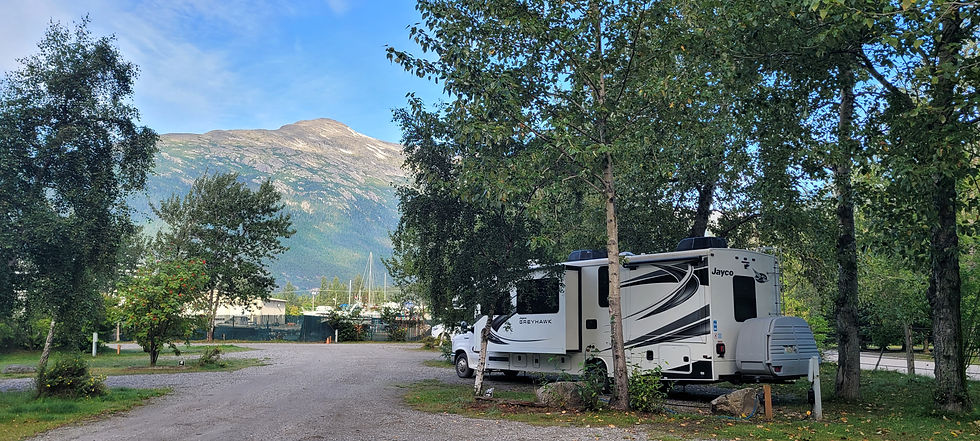
Other RV travelers have dismissed Skagway as over-touristed, full of expensive boutique shops, and without a proper RV park. But we found it delightful! We stayed at a town RV park very near the cruise ship docks and the historical narrow-gauge railway line. We enjoyed watching multi-generational families, romantic couples, and lively groups of friends, from all over the world, disembark to discover this corner of Alaska. Sure, the shops were boutique-y, but they also had some lovely indigenous artworks, jewelry, and Ulu knives. Sure, other tourist destinations have narrow-gauge railways, but this one included truly spectacular scenery, an international border, and views of the historic "Dead Horse Trail" to the Klondike Gold Fields, which the railway replaced in 1899. Sure, "The Days of '98 Show with Soapy Smith" was kitschy vaudeville theater (on stage since 1923!), but there's lots of history more seriously presented at the Klondike Gold Rush National Historical Site Visitor Center and throughout town.
The information board for the cruise ship passengers, updated each morning with ship names; the main shopping & dining street after most of the passengers had re-boarded their ships; the fraternal Arctic Brotherhood Hall of 1899, now the Tourist Information Center, with 60% of the 8,800 pieces of exterior driftwood still the originals (Skagway, Alaska).
(1) The White Pass & Yukon Route Railway ran commercially from 1900 to 1982. Originally built to replace the deadly White Pass ("Dead Horse") Trail for the Klondike gold seekers, it carried copper, silver, lead, and, much later, zinc ore from area mines, as well as passengers, to Whitehorse, Yukon, to transfer there to Dawson City, Yukon, by boat. From 1942-1944, the U.S. Army commandeered the railway to carry supplies for the building of the Alaska Highway (the main construction camp, Camp Takhini, was in Whitehorse, Yukon). The Railway re-opened in 1988 as a heritage railway for tourists. (2) Because Canada required Klondike gold seekers to carry a literal ton of supplies with them (enough to last one year), a North-West Mounted Police inspection station was set up at the Alaska/Yukon border. The replica station flies five flags, for the U.S., Alaska, British Columbia, Yukon, and Canada. (3) A view looking down from the Railway at the narrow and treacherous White Pass Trail. (4) A view of the Skagway River alongside the Railway.
Vaudeville history; and one of many historical signs around town (Skagway, Alaska).
There was also wildlife activity in Skagway. The humpback (pink) salmon were spawning en masse in Pullen Creek, right across from our campground. And when the tide was high, the harbor seals (unsportingly) staged themselves in the lower part of the salmon ladder to more easily catch a meal! Other times, seals could be seen swimming and diving right next to a massive cruise ship to chase the salmon.
Pink (humpback) salmon congregating in the Skagway Harbor before swimming up the fish ladder into Pullen Creek; salmon spawning in Pullen Creek under the poplars; a group of post-spawning, decaying (note the white areas) "zombie fish" swimming feebly until they die. Their flesh will add nutrients to the streambed and streambanks and will feed area birds; any poorly buried eggs may feed fish such as Dolly Varden and Rainbow Trout. Up the Chilkoot River in Haines, across the Chilkoot Inlet from Skagway, bears will feast on the spawning "humpies" (especially the females' rich eggs and skin) and Coho salmon will eat any poorly buried eggs.
Harbor seals fishing in the harbor salmon ladder at the Pullen Creek outflow; harbor seal enjoying his catch; harbor salmon ladder at low tide for comparison.
We also enjoyed a variety of wildlife watching on ferries and nature cruises in the Taiya Inlet/Lynn Canal fjord (Alison and our friend Sarah, who joined us for a week), and a glimpse of a bear fishing on the Chilkoot River during a tour of Haines (Alison, Doug, and Sarah).
The size of a humpback whale tail next to Alison (Juneau, Alaska); the tail patterns of the humpback whales in the Juneau area, provided by the wildlife cruise naturalist; young male Steller sea lions hanging out on a bell buoy (Saginaw Channel of Lynn Canal inlet near Juneau, Alaska); glimpse of a brown bear fishing for salmon on the Chilkoot River in Haines, Alaska. (City and state rules didn't allow stopping for better pictures!) (Alison and Sarah also saw humpback whale blows and surfacings, but Alison didn't capture any good pictures.)
At the end of each day, we also enjoyed watching the cruise ship crews pull in the giant mooring lines, and then the immense ships steam surprisingly quietly and quickly away. Then it was time for a late dinner, along with the locals, at the emptied-out restaurants.
The weekly barge arrives; a cruise ship departs (Skagway, Alaska).
Skagway is also known as one of only two Inland Passage towns (along with Haines) that is accessible by road. Ferries from Skagway travel down to Juneau, Sitka, and Ketchikan, which can otherwise only be reached by air. We had originally hoped to travel this Inside Passage and return to Bellingham, Washington, with our RV, but the combination of scheduling difficulties and high cost led us to scrap that plan and instead drive back out of Alaska after visiting Skagway. So Ketchikan (where Alison's dad managed a donut shop for a time when he was young!) will have to wait for another trip. Perhaps a cruise!
Alaska Marine Highway ferry (sadly, the Skagway, Alaska ferry dock buckled the following summer, August 2026, and is under repair; passenger traffic has been diverted to private ferries, and vehicle traffic to the Alaska Marine Highway dock in Haines, Alaska); inlet and waterfall views from the Alaska Marine Highway ferry to Juneau; view of the quaint town of Haines, Alaska, population about 1,700 residents, from the high speed passenger ferry; Eldred Rock lighthouse with sea otter in foreground, from the Juneau-to-Skagway wildlife passenger ferry; Chilkoot Lake in Haines, Alaska.
In any case, Alison did get to visit Juneau when her best friend from college, Sarah, flew into there, and then joined us in Skagway for a few days.

Mendenhall Glacier is one of the many gorgeous glaciers in Alaska. As with most of them, it is decreasing in size. It has receded a bit over a mile in the past 40 years, and was noted in November 2025 as no longer terminating in Mendenhall Lake, a few months after this photo was taken.
The melting of the glacier is what kept us from taking the rig to Juneau as we had planned. A side basin, Suicide Basin, can overfill and melt the ice dam keeping the rainwater and meltwater contained, letting water flow under the glacier and into Mendenhall Lake, which then itself overflows into Juneau, including the campground we had reserved!
Alison and Sarah found the glacier and lake and visitor center still to be worth a visit, both beautiful and interesting.
Juneau itself is built on Mount Juneau and Mount Roberts, side-by-side peaks of the Boundary Ranges of the Coast Mountains that run down to western British Columbia. The town is very hilly, but walkable, as long as you can navigate the stairways!
One of the many steep stairways, both public and private, that are used to navigate Juneau's neighborhoods; a view of the Gastineau Channel from above.
Juneau was first settled in 1880 during a gold rush, and its increasing wealth and population led to it being selected as the territorial capital in 1906 and the state capital in 1959. Gold mining ceased in 1944, and government replaced it as Juneau's primary industry. Initiatives from the 1970s to the 2000s to move the capital to Anchorage (currently nine times more populous, and with road and rail access) have continued to fail due to the estimated expense. Currently, tourism based in wildlife tours and in indigenous history and culture are Juneau's other main industry. (1) Statue honoring hard rock miners (gold, silver, copper, zinc, and lead) in Marine Park in downtown Juneau. (2) Statue in the capitol area of Juneau honoring William H. Seward, the Secretary of State who negotiated the U.S. purchase of the Alaska Territory from Russia in 1867. (3) Totem pole in front of the Governor's house, carved by Tlingit craftsmen in 1940. (4) One of fourteen Totem Pole Trail totem poles on Juneau's Seawalk.
Life-size fountain sculpture of a 40-foot male humpback whale breaching (Seawalk, Juneau, Alaska).
Juneau had wonderful museums: The Sealaska Heritage Institute near the waterfront, with its totem poles outside and its full replica of a cedar clan house inside; the Juneau-Douglas City Museum near the Capitol, with a very interesting timeline of Alaska history as well as exhibits and artifacts; the St. Nicholas Orthodox Church historic site; the Last Chance Mining Museum (which we, unfortunately, didn't have time to visit); and the Alaska State Museum.
St. Nicholas Orthodox Church, a still-active church
built by Serbian miners and Tlingit residents in 1894
(Juneau, Alaska).
(1) The Alaska State Museum has a "Wonder Wall" of Alaska wildlife specimens when entering the exhibits area. (2) In addition to a permanent collection of some 32,000 items of natural and human history in Alaska, there was a beautiful temporary exhibit of Boreal Forest art. (3) Artist Susan Campbell's "Boreal Colloquy", made up of bark cuttings from birch, black spruce, white spruce, tamarack, balsam poplar, aspen, willow, and alder, with leaves and related natural items, was particularly beautiful. (Alaska State Museum, Juneau, Alaska)
Giant ravens abounded throughout the north; skunk cabbage wilts in the late summer (when black bears emerge in the spring, they eat it to restart their digestive and elimination processes!) (Juneau, Alaska).
After Sarah flew back to the lower 48 from Juneau's airport, Alison flew back to Skagway on a bush plane (from the airport, not the harbor, so not a seaplane, alas!)
(1) Seaplane takes off from Juneau Harbor. (2) Alison's bush plane exterior and (3) interior. (4) Juneau and Mendenhall Glacier from the air. (5) Coastline and pothole (or kettle) lake, created when a dug-in ice chunk left behind by a retreating glacier melted. (6) Silty glacial runoff mixes with clear Lynn Canal inlet water.
Skagway was our final Alaska destination. It was time to head back south...

Coming up: Our completion blog post from this trip, detailing our final travels through and out of Canada.


Comments