top of page
Search

Alaska: The Kenai Peninsula

  • Writer: Alison (No Fixed Address)
    Alison (No Fixed Address)
  • 1 day ago
  • 5 min read

A view of the Kenai Peninsula, leaving Anchorage, Alaska, on the Seward Highway.  (All photos by author unless otherwise credited)
A view of the Kenai Peninsula, leaving Anchorage, Alaska, on the Seward Highway. (All photos by author unless otherwise credited)

The Kenai Peninsula of Alaska is renowned for its glaciers, fjords, and wildlife. (It's also the departure point for bush flights west, to Lake Clark National Park/Preserve and Katmai National Park/Preserve, but we did not fit those into our travels.) We camped for a few days each in the towns of Seward and Homer at the end of July. On our way onto the peninsula, we stopped at the Alaska Wildlife Conservation Center and the Portage Isthmus/Valley/Lake/Glacier.


Black bear at the Alaska Wildlife Conservation Center, which also hosts brown bears, elk, reindeer, moose, wood bison, muskoxen, and other native wildlife (Girdwood, Alaska, a gateway town to the Kenai Peninsula).

Boat trip to the 6-mile long Portage Glacier at its terminus in Portage Lake, Alaska, on the Portage Valley Isthmus between Anchorage and the Kenai Peninsula.  Like all the glaciers we saw in Alaska, this one is retreating; it once filled the entire 14-mile Valley.
Boat trip to the 6-mile long Portage Glacier at its terminus in Portage Lake, Alaska, on the Portage Valley Isthmus between Anchorage and the Kenai Peninsula. Like all the glaciers we saw in Alaska, this one is retreating; it once filled the entire 14-mile Valley.

Seward is a beautiful harbor and year-round deepwater port town on the shore of Resurrection Bay of the Gulf of Alaska. It was first a home of the Alutiik indigenous people, then a Russian fur trading post (1793), then a homestead for American Franklin G. Lowell (1884), then a town founded in 1903 by brothers Frank and John Ballaine as the southern terminus of a proposed railroad from Fairbanks. The Ballaines purchased the land from Franklin Lowell's second wife and named the town after William H. Seward, the U.S. Secretary of State who had negotiated the purchase of Alaska from Russia six years prior (1897).


Seward Harbor, with a cruise ship in the background (Seward, Alaska).

We took an amazing all-day cruise with Major Marine Tours in the Kenai Fjords National Park (and a bit into the Gulf of Alaska). It was a fantastic experience, and cell phone photos really cannot do it justice. (Several passengers had fancy cameras with very long zoom lenses.) We saw sea otters, harbor seals, and Stellar sea lions; humpback whales, orca whales, and Dall's porpoises; and tufted puffins, horned puffins, and other northern seabirds. The humpback whales were spectacular, coming up to breathe (spout) before diving to bubble-net feed, a cooperative circling and driving upward of tiny fish with bubbles, then surfacing with mouths wide open to strain the meal through their baleen. (There are some great videos of this on YouTube, by photographers with better skills and equipment than us!) The orcas were transient killer whales, hunting sea mammals; we didn't see any resident orca whales (on this cruise), which feed on fish. The black and white Dall's porpoises were fun to watch as they surfed our bow wave.


Approaching the mouth of a fjord, with hillsides of bright green Sitka spruce and mountain hemlock; glimpsing a glacier at the head (the inland end) of a fjord; a glacier terminus (the ice really was that blue, because the extremely compressed ice absorbs the longer wavelengths of red and yellow light and reflects only the shorter wavelengths of blue light). There are about 40 glaciers (covering 400 square miles) that are spawned from the Harding Icefield (covering 700 square miles) in Kenai Fjords National Park, Alaska.


Sea otter in open water; harbor seals on floating glacier ice; Stellar sea lions on rocky ledges (Kenai Fjords National Park, Alaska).


Humpback whales (which can reach lengths of 50 feet) surfacing to spout near our cruise boat (Kenai Fjords National Park, Alaska).

Sea stacks and cliff tops hosting crowds of nesting puffins; horned puffin floating in open water. Puffins are incredibly cute, fat and flappy birds! (Kenai Fjords National Park, Alaska)


The elusive Giant Pacific Octopus, on display at the Alaska SeaLife Center, an aquarium and research facility in Seward, Alaska.

Leaving Seward, we turned onto the Sterling Highway and made a quick stop at the Russian River, but we were in between the two sockeye salmon runs which draw brown and black bears to the Russian River Falls and the Russian/Kenai Rivers confluence. So no bear sightings, alas! Stunning scenery, however, both on the way and at the river:


In the Chugach National Forest: a mirror-still Tern Lake; close-up of trumpeter swans in Tern Lake; clear water of the Russian River (Kenai Peninsula, Alaska).


The town of Homer is known for world-class fishing (especially halibut and salmon), local artists, and peonies (Homer's micro-climate is uniquely suited for commercially-grown peonies that bloom just in time for summer weddings)!


Peonies and delphiniums at Baycrest Overlook Park (Homer, Alaska).

The harbor has floating docks and gangways that can rise and fall with the 25' tidal change (Homer, Alaska).

Our campsite (our rig is first on left in this picture) on the Homer Spit, a 4.5-mile long finger of land jutting into the Kachemak Bay.  To the right, we e-biked into town; to the left, we e-biked to the harbor, restaurants, art galleries, and shops at the end of the Spit (Homer, Alaska).
Our campsite (our rig is first on left in this picture) on the Homer Spit, a 4.5-mile long finger of land jutting into the Kachemak Bay. To the right, we e-biked into town; to the left, we e-biked to the harbor, restaurants, art galleries, and shops at the end of the Spit (Homer, Alaska).

Visiting anglers transform salmon fish to salmon fillets (Homer, Alaska).


Homer's "Circle Hook" sculpture honors the town's status of "Halibut Fishing Capital of the World" (Homer, Alaska); an indigenous halibut hook (photo courtesy of Anchorage Museum).


Northern Flora quilt that was being raffled at the small but impressive Pratt Museum, which displays art and artifacts about the culture, history, and ecology of the Kenai Peninsula.  The quilt features the following branches around the edges:  willow in the corners, birch and spruce at the top and bottom, and aspen and cedar at the right and left.  The featured flowers, from left to right, top to bottom:  Chocolate Lily, Forget-Me-Not, Black Current; Beach Pea, Lupine; Wild Rose, Wild Iris, Wild Geranium; Fireweed, Cranberry; Paintbrush, Poppy, Blueberry; Chiming Bells, Daisy; Columbine, Strawberry, Raspberry.  The Pratt Museum also displayed a less beautiful but very interesting exhibit on the "Exxon Valdez" oil spill (1989), in which over 10 million gallons of crude oil drained from the reef-grounded ship into Prince William Sound, some 180 miles northeast of Homer, Alaska.
Northern Flora quilt that was being raffled at the small but impressive Pratt Museum, which displays art and artifacts about the culture, history, and ecology of the Kenai Peninsula. The quilt features the following branches around the edges: willow in the corners, birch and spruce at the top and bottom, and aspen and cedar at the right and left. The featured flowers, from left to right, top to bottom: Chocolate Lily, Forget-Me-Not, Black Current; Beach Pea, Lupine; Wild Rose, Wild Iris, Wild Geranium; Fireweed, Cranberry; Paintbrush, Poppy, Blueberry; Chiming Bells, Daisy; Columbine, Strawberry, Raspberry. The Pratt Museum also displayed a less beautiful but very interesting exhibit on the "Exxon Valdez" oil spill (1989), in which over 10 million gallons of crude oil drained from the reef-grounded ship into Prince William Sound, some 180 miles northeast of Homer, Alaska.

We also toured the Islands and Oceans Visitor Center for the Alaska Maritime National Wildlife Refuge. President Theodore Roosevelt established the first National Wildlife Refuge (NWR) in 1903, in Florida; there are now 573 throughout the 50 states. The Alaska Maritime NWR is comprised of Alaska's western and southern coasts, including the Aleutian Islands and the Inside Passage islands. The Visitor Center does a wonderful job of explaining and displaying the cultural and ecological history of the area, including Russian and European over-hunting of sea otters, fur seals, and walruses; purposeful introduction of foxes and accidental introduction of rats (both vastly harming the native bird populations); underground nuclear testing; the "Exxon Valdez" oil spill; and more hopeful narratives of research and restoration.


(Display, Islands and Oceans Visitor Center for the Alaska Maritime National Wildlife Refuge, Homer, Alaska)

Finally, although we did not make it west across the Cook Inlet to the Lake Clark/Katmai National Parks/Preserves, we could see the volcanic range there from Homer:
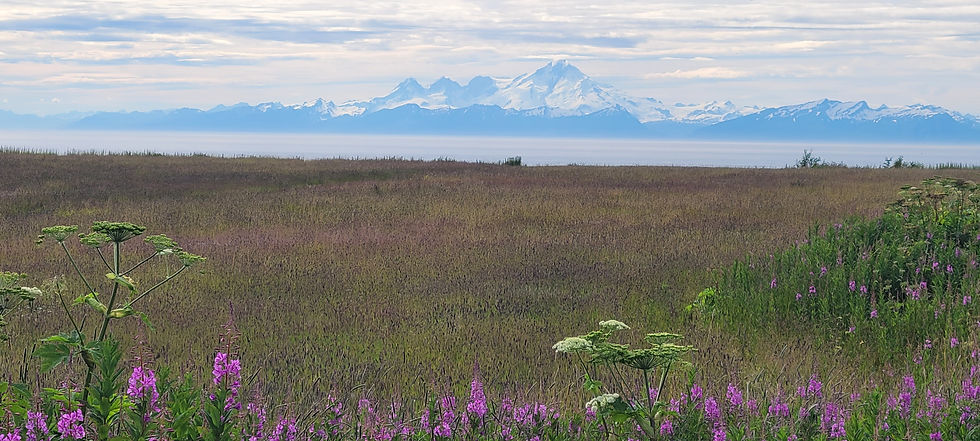

There are at least four active volcanoes within 120 miles of Homer, Alaska, two of which erupted in the early 2000's (Mount Redoubt and Mount Augustine) and one of which was a little restive in the Summer of 2025 (Mount Spurr), so we kept an eye on the reporting website for it.  These previous eruptions deposited ash on Homer and Anchorage!
There are at least four active volcanoes within 120 miles of Homer, Alaska, two of which erupted in the early 2000's (Mount Redoubt and Mount Augustine) and one of which was a little restive in the Summer of 2025 (Mount Spurr), so we kept an eye on the reporting website for it. These previous eruptions deposited ash on Homer and Anchorage!

After our return to Anchorage, we drove to a campground within Denali National Park. More on our stay there (including an encounter with a caribou!) in our next blog post!
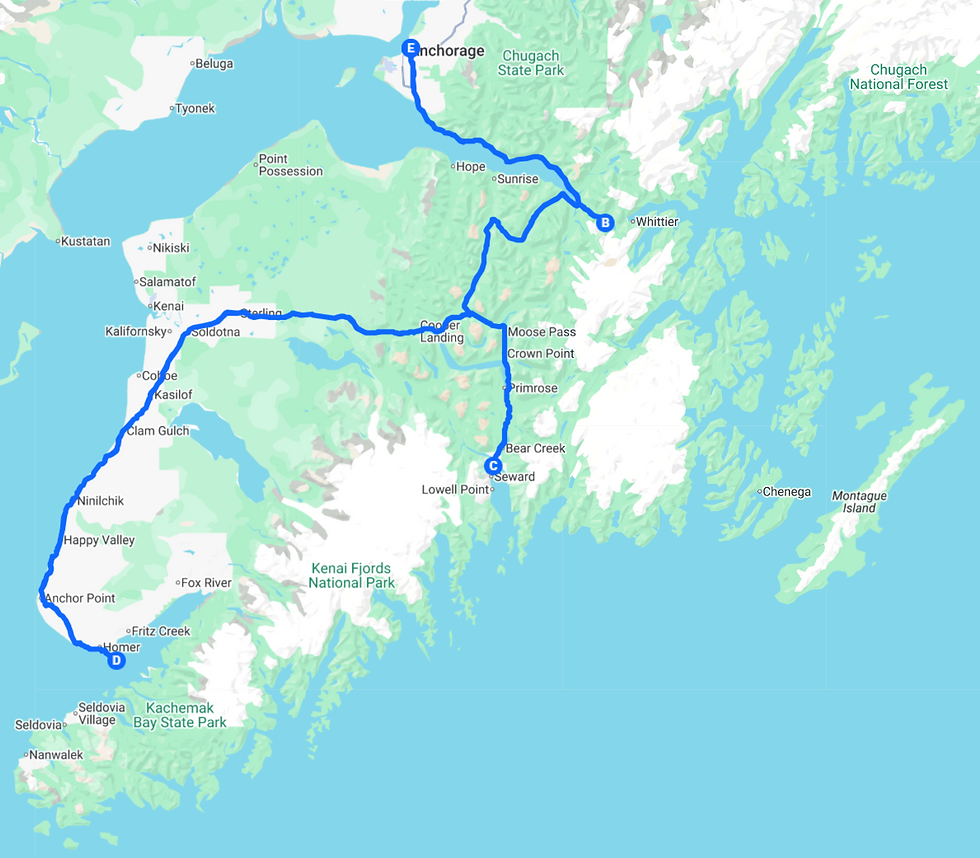


July 25-30, 2025:  Anchorage to Kenai Peninsula and back.  Total miles driven from Bellingham, Washington, on May 30, 2025, through Anchorage, Alaska, on August 3, 2025:  3,969 miles.
July 25-30, 2025: Anchorage to Kenai Peninsula and back. Total miles driven from Bellingham, Washington, on May 30, 2025, through Anchorage, Alaska, on August 3, 2025: 3,969 miles.


Comments


  • instagram
  • Facebook

©2025 by No Fixed Address Travels. Proudly created with Wix.com

bottom of page